Philosophy
What This Means for You
Healing Made Whole is not simply a collection of health recommendations. It is a way of thinking about the body, health, and everyday life.
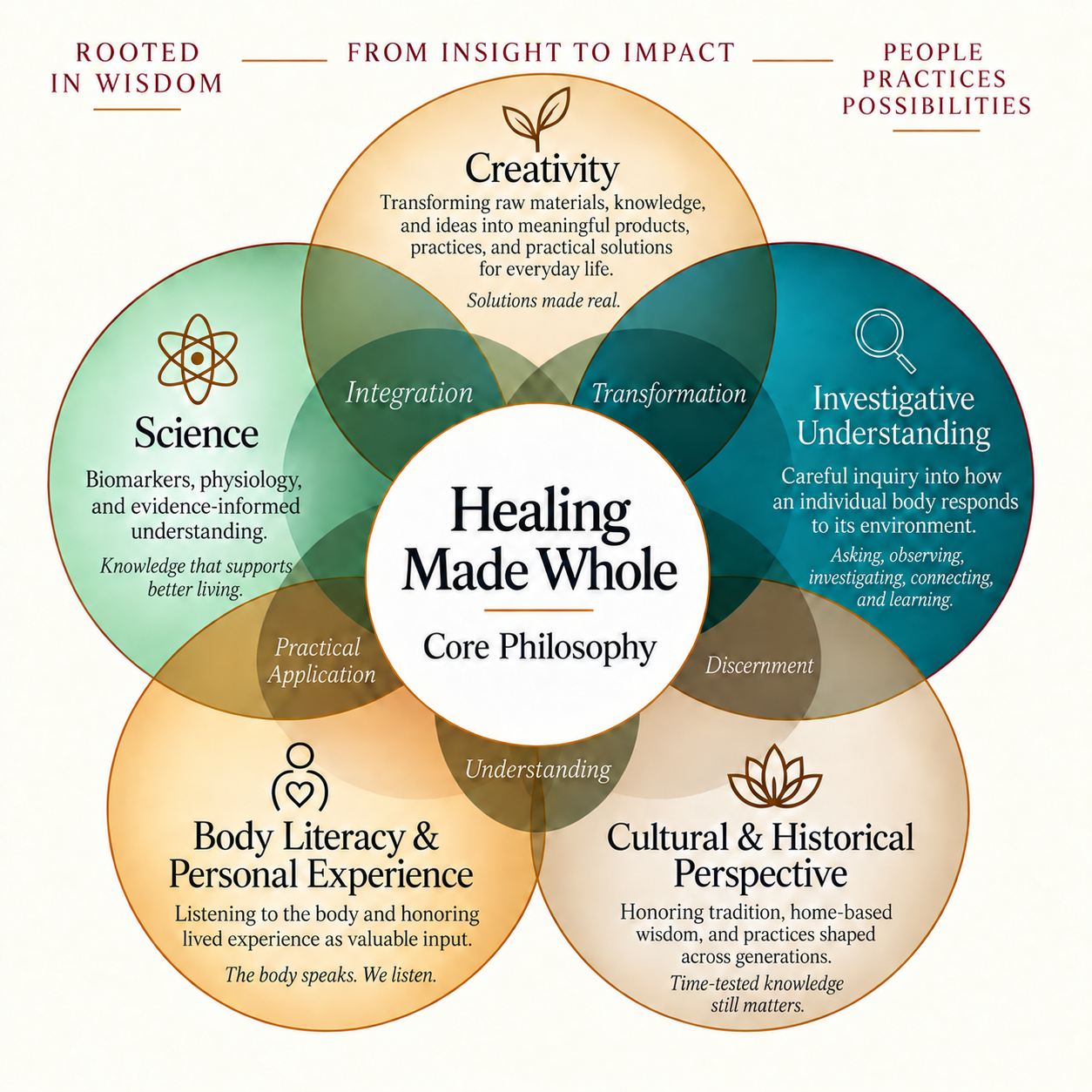
We encourage people to ask better questions, develop greater body literacy, understand the science that matters, consider the wisdom carried through culture and history, investigate patterns and relationships, and creatively translate what they learn into real life.
Science
What do I understand about how my body works—and what do I still need to learn?
Do I understand the basic physiology behind the health decisions I am making?
You do not need to be a scientist or clinician to understand your body. Basic knowledge about metabolism, inflammation, blood sugar regulation, muscle, connective tissue, nutrition, sleep, movement, and other aspects of physiology can make health information more meaningful and useful.
Investigative Understanding
Do I understand how my lifestyle, environment, and behaviors may be influencing what is happening in my body?
What patterns or connections become visible when I look more closely?
Investigative understanding means asking questions, observing patterns, examining relationships, and remaining willing to learn. It moves us beyond knowing isolated facts toward understanding how different factors may work together in an individual life.
Body Literacy & Personal Experience
What is my body telling me?
What changes have I noticed in how I feel, function, recover, move, sleep, digest, think, or respond over time?
The body provides information. Symptoms, energy, strength, discomfort, recovery, mood, appetite, sleep, and other experiences can all become useful observations when considered thoughtfully and in context.
Cultural & Historical Perspective
What knowledge, practices, or ways of living have shaped how I understand health—and what may still be worth carrying forward?
What can I learn from the ways people and cultures have supported health across generations, while still evaluating those practices in light of what we know today?
Not everything valuable began with modern health care, and not everything traditional should be accepted without examination. Historical and cultural perspective gives us another source of knowledge to consider, understand, and place in context.
Creativity
How can I make what I know actually work in my life?
What practical or creative solution could make a healthy practice easier, more meaningful, or more sustainable for me?
Knowledge does not automatically become behavior. Creativity helps bridge that gap. It may mean redesigning a routine, changing an environment, creating a ritual, finding a different way to move, preparing food differently, using supportive products or tools, or solving a problem in a way that fits the realities of everyday life.
The Questions Continue
These same principles can be applied beyond the individual.
We can also ask:
Are we measuring the things that help people understand their health early enough?
Are people being given enough information to understand what their results mean?
Are useful tools, testing, education, and preventive resources accessible to the people who need them?
Are health systems helping people move from information to understanding—and from understanding to meaningful action?
Healing Made Whole applies these questions at the level of the individual, the family, the community, and the systems that influence health.
The goal is not simply to know more.
It is to understand more deeply, discern more clearly, apply knowledge more meaningfully, and create the conditions for transformation.
Stewardship
At Healing Made Whole, we believe that understanding the body changes the way we care for it.
The goal is not to teach people to become their own doctors or to navigate health entirely on their own. It is to help people become more informed and engaged stewards of their bodies—to notice, to ask questions, to understand, to make connections, and to participate meaningfully in decisions that affect their health and everyday lives.
Stewardship begins with learning to live within the body with greater awareness.
What is my body communicating?
What do I understand about what is happening within it?
What do I still need to learn or investigate?
What practices support the way I want to feel, function, age, and live?
Where do I need guidance, partnership, or care from others?
Stewardship also extends beyond the individual. Those entrusted with the health of communities, healthcare systems, education, and public health have a role in continually reassessing whether people have meaningful access to the knowledge, tools, testing, and support needed to understand and care for their health. Good stewardship asks not only what is available, but whether what matters is being recognized, communicated, and made accessible across communities.
Knowledge gives us information. Understanding allows us to put that information into context. Discernment helps us determine what matters. Practical application moves understanding into everyday life. And over time, those practices can create the conditions for transformation.
This is the work of stewardship: not controlling every outcome, but learning to care intentionally for what has been entrusted to us.
“Wisdom is the principal thing; therefore get wisdom: and with all thy getting get understanding.”
— Proverbs 4:7, KJV
Healing is the journey. Being made whole is the possibility.
Healing Made Whole provides education and supportive resources and does not provide medical diagnosis or treatment. Educational content and services are intended to complement, not replace, care from qualified healthcare professionals.